
Greenwashing is everywhere in the organic mattress industry. This quick guide shows you how to choose a truly eco-friendly mattress—safe, non-toxic, and made to last.
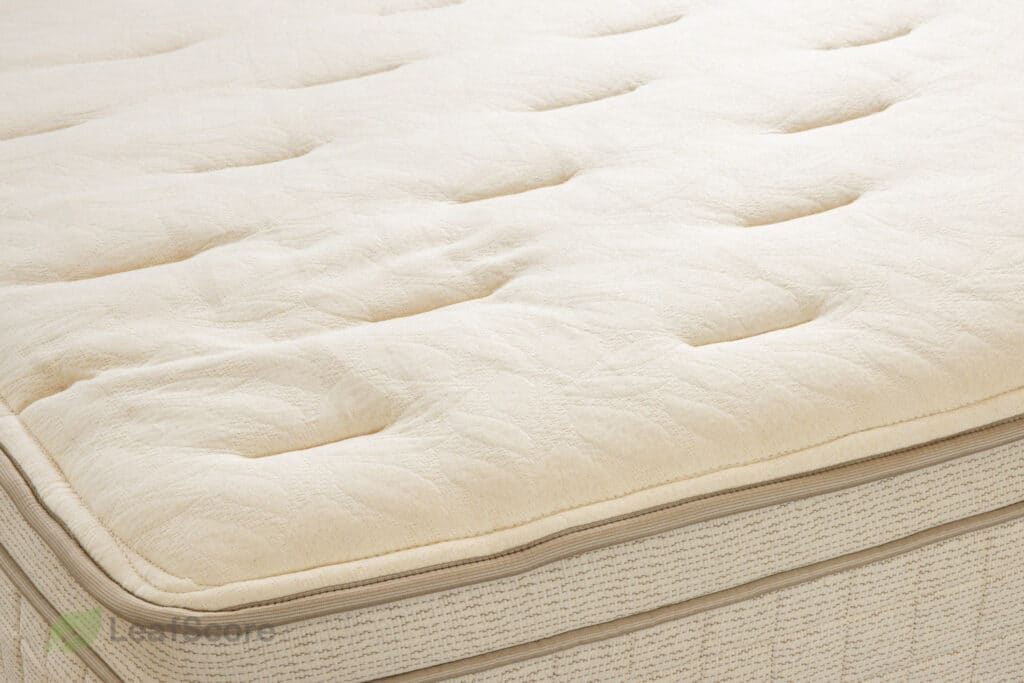
For the health of people and planet, we favor eco-friendly, natural materials for mattresses at Leaf Score. How do you choose a non-toxic mattress, though?
Let’s look beyond any marketing hype (‘eco-foam’, etc.) and start with the basics: recognizable, time-tested, natural materials.
Non-toxic mattress materials
The core of a good quality, non-toxic mattress should comprise:
- Natural or organic latex from rubber trees – check certifications to make sure it is natural and not a synthetic rubber blend (see below)
- Certified organic cotton for ticking and batting
- Certified organic wool – used as a natural flame barrier and temperature regulator
- Recycled steel coils – ideally individually wrapped with cotton or polylactic acid (PLA) made from natural materials.
In some cases, non-toxic mattresses will include a tiny fraction of nylon thread to help hold batting together. Don’t let this deter you from choosing an otherwise natural mattress. From the bigger picture perspective, this small amount of synthetic thread could mean the difference between a mattress that performs well for 30 years and one that falls apart or becomes uncomfortable in less than 5 years.
What to avoid in your search:
- Polyurethane and memory foam
- ‘Eco-foam’, plant-based foams, soy foams, etc. – these are predominantly petrochemicals
- Polyester batting
- Latex hybrid blends – a mix of synthetic rubber and some natural latex
- Cotton blends – synthetic fibers with some cotton.
If a mattress company doesn’t detail the material composition of a mattress, or uses terms like ‘cotton blend’ or ‘latex blend’, be wary. You can always reach out to the company for more precise material information, but to save time and energy you might just want to move on to look at more transparent companies.
Certifications for mattresses
There are many certifications you’re likely to see on mattresses. Some of these are more meaningful than others.
The ones you want to look for are:
- Global Organic Latex Standard (GOLS) – for any mattress that contains latex, as this rules out synthetic latex and many chemicals best avoided
- Global Organic Textile Standard (GOTS) – for all mattresses, ideally, as this requires at least 95% certified organic fibers in the finished product and absolutely no polyurethane foam, conventional flame retardants, or many other hazardous substances
- MADE SAFE – this certification scheme screens finished products for thousands of known and suspected toxicants, focusing on human and environmental health.
If you see the OEKO-TEX Standard 100 certification on a mattress, this can be both a good and a bad sign. Good because it suggests that the synthetic parts of a mattress are largely free of the worst kinds of hazardous chemicals; bad because it suggests that the mattress is made with too many synthetic materials to qualify under the GOTS, GOLS, or Made Safe certification programs.
Typically, if a mattress carries any of these certifications, or a combination of them, this signals it is a non-toxic mattress.
If you aren’t sure, check the mattress listing or contact the company for more information on:
- Which components are certified, by whom, and to what standard
- Any adhesives
- Any flame‑barriers or retardants
- Any fabric/surface treatments for stain or microbial resistance.
If the answers aren’t transparent and satisfactory, move on.
Red flags on mattresses
When choosing a non-toxic mattress, beware vague claims such as:
- 100% natural
- 100% organic cotton
- Certified safe
- Low VOC.
Without exact material listings and certifications, these marketing statements mean very little and may well be a sign of a brand greenwashing its products.
Even if you see a certification logo on a product listing, check to see a registration or certification number. Cross reference this with the GOTS, GOLS, or MadeSafe directory. I have come across listings that just photoshop in a GOTS logo but are very definitely misusing the certification (and I’ve notified GOTS of this, which is also something you can do!).
Final thoughts
Choosing a non-toxic mattress actually needn’t be that hard. By filtering out the mattresses that don’t carry legitimate non-toxic and eco-friendly credentials, you can quickly get a solid short list to choose from.
After that, you’re really looking for good info on things like:
- Mattress firmness and comfort per your sleep style
- Motion transfer
- Ability to adjust layers
- How the mattress is delivered (vacuum sealed, or self-assembly, etc.)
- Returns and sleep trials
- Warranty and longevity
- Price (plus delivery cost).
Finally, when choosing your mattress, consider any existing mattress toppers, bedding, or protectors you have. Will these work with your new mattress? Is it time to upgrade those items too? Working with what you have already is definitely the most eco-friendly and budget-friendly option, but if you need to ditch worn or synthetic items, we have guides for choosing non-toxic mattress toppers, bedding, and protectors too.