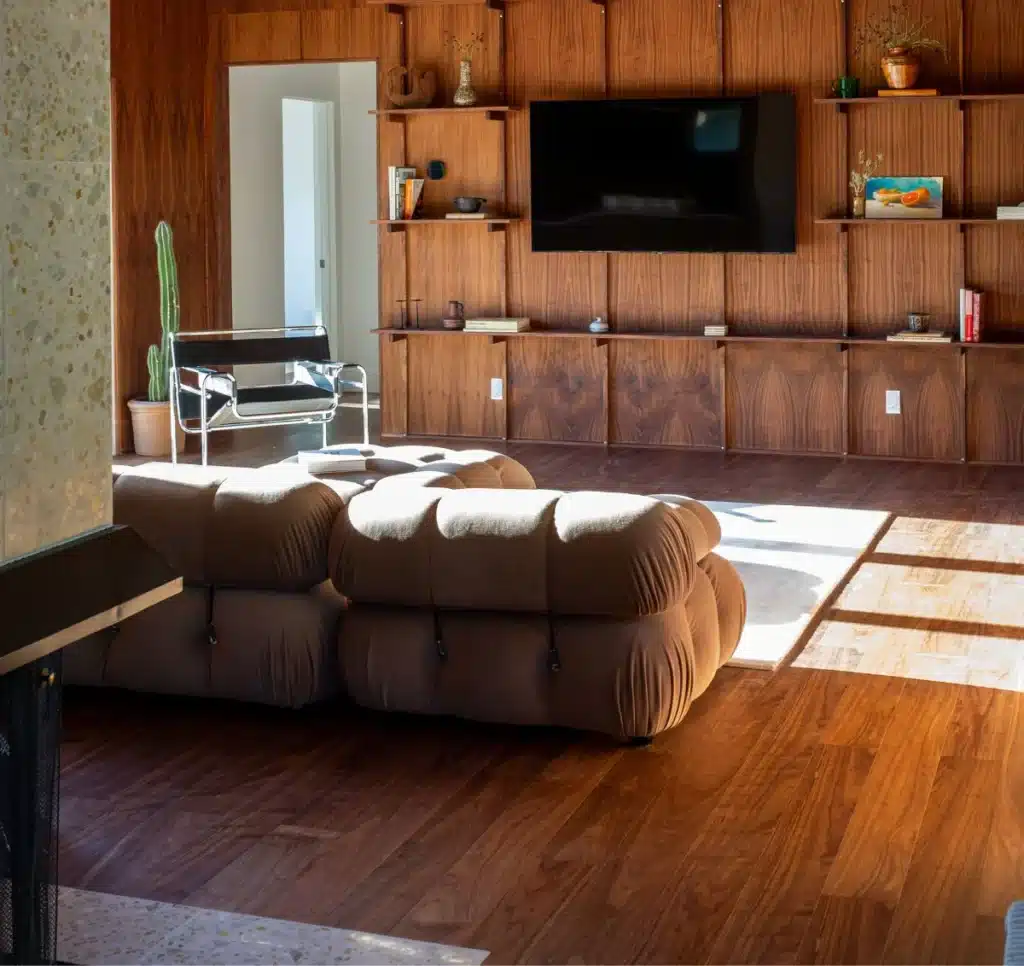
Stuga is a relatively new entrant to the non-toxic flooring market, and with the cost of wood flooring only increasing, the brand fills an important role in the marketplace by cutting out the middleman to offer a quality product at better rates than many hardwood showroom offerings. Overall, you’re looking at an average of $8-10 per square foot for most Stuga products. The branding is gorgeous. Just browsing the website had us fired up and ready to make a purchase, but before we dive in and get out the credit card, the customary sustainability analysis.
Stuga products are made in Sweden and the brand seems to be partnered with Kährs, a longtime producer of flooring in Scandinavia.
The brand boasts several core certifications, two of which are actually regulatory frameworks:
- CARB 2 — California formaldehyde emission standard (required by US law, not voluntary)
- Nordic Ecolabel — Scandinavia’s official eco-certification, covers full lifecycle
- CE — EU compliance marking (required for sale in Europe, not voluntary)
- FloorScore — Indoor air quality certification by SCS Global Services
- M1 Emission Class — Finnish standard for building materials, strictest emission class
- ISO 9001 & 14001 — quality and environmental management systems. Their supplier got ISO 9001 in 1993 and ISO 14001 in 1997 — first wood floor manufacturer to do so.
- LEED contribution — their FloorScore certification means their products qualify for points in LEED building projects.
We love that Stuga gives a tip of the hat to indoor air quality, which is perhaps the most important forgotten issue in sustainability. Off-gassing and VOC burden are issues we have been focused on at LeafScore for years, and Stuga deserves credit for leaning in and taking responsibility for how its flooring can impact environmental health in positive ways.
Further, by manufacturing in Sweden, the brand is positioned in a jurisdiction that is rigorous about worker’s rights. This means Stuga workers enjoy 480 days of paid parental leave, and a 40 hour workweek, but the country currently has no statutorily mandated minimum wage, so it’s unclear how Stuga pays its workers.
Stuga uses European white oak for all its products in the Icon line, and a pine core. If your goal is the most pristine product from the catalogue, the Icon line with the water based finish is best in class. The oil finish floors require annual oiling with Satin Oil, which is made of n-Paraffin C5-20 (essentially kerosene) with 771 g/l of VOCs. For a brand marketing itself as non-toxic, that’s a notable asterisk. The acrylic urethane (water-based) finish doesn’t have this issue.
European white oak is considered highly sustainable because it’s sourced from managed forests and the end product lasts for decades. The pine core is a differentiator. It’s the (no pun intended) core of why these floors are considered non-toxic vs. competitors using plywood or particle board cores with adhesives.
The Rebel line has an HDF/MDF-type core with formaldehyde emissions (low, but present). It’s unclear to us based on our review of publicly available information if the Rebels line is Greenguard Gold certified. Some blogs say yes, but a review of the product page didn’t show the badge.
There are also some questions about the supplier for some of these SKUs, which was raised in this blog post by commenter, Brad.