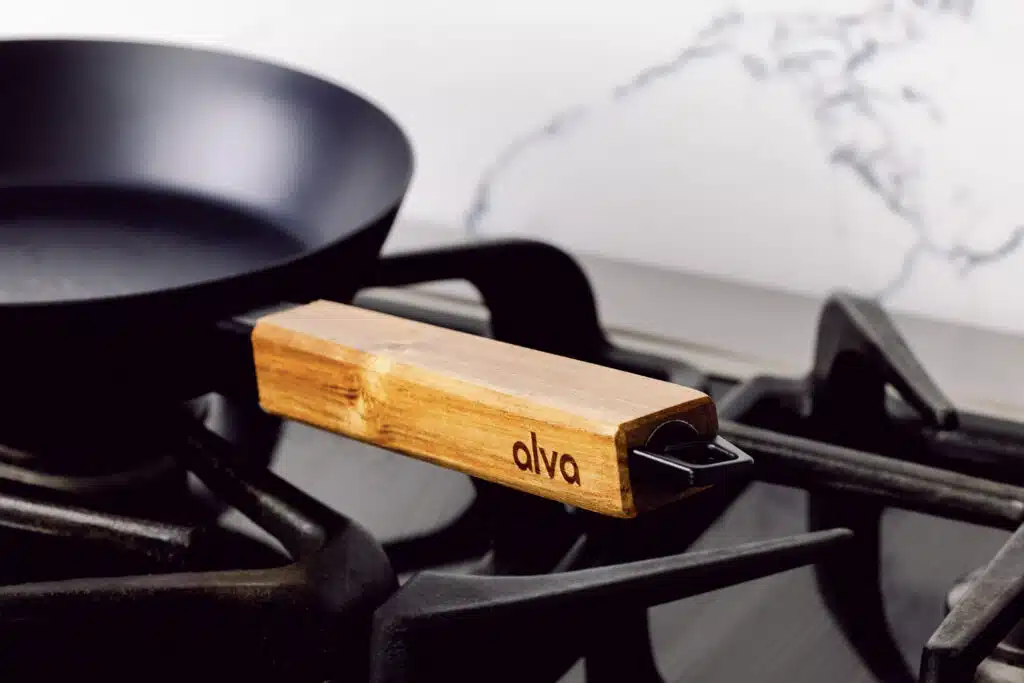
Alva’s origins are impressively sustainable. The first pots and pans created by the cookware company’s founder Albert Vandaele were made using recycled military materials in post-World War II Belgium. Chances are that those pots and pans wouldn’t pass today’s safety tests for heavy metals and contaminants, but the modern versions certainly do. And, even better, the company still has a strong commitment to sourcing safe and sustainable recycled materials such as aluminum.
Alva’s factory also runs on 30% solar power and the facility has in-house water filtration to keep things clean and prevent wastewater pollution. In addition, the design and manufacture of Alva cookware is more energy efficient than some other companies’ methods, with less carbon dioxide emissions associated with the curing phase of cookware production.
Our Alva cookware samples have always arrived in one big sturdy box with very little packaging material inside. Alva smartly protects its pots and pans with tissue paper and cardboard and only uses a tiny amount of inflated LDPE #4 recyclable plastic as cushioning. There are no single-use plastics on the cookware as hang tags. In fact, Alva has smart cardboard packaging designs that fold and slot together, so there’s no need for glue in the first place. With the Forest Wok, Alva cleverly uses a small magnet rather than glue to keep the packaging in place.
When I first encountered Alva Cookware, I admit to being very skeptical. I almost wrote off the company as another cookware brand trying to pass off non-stick cookware as non-toxic. Fortunately, I asked the company to get test results and after some back and forth I was given a raft of reports from Alva’s testing in the European Union.
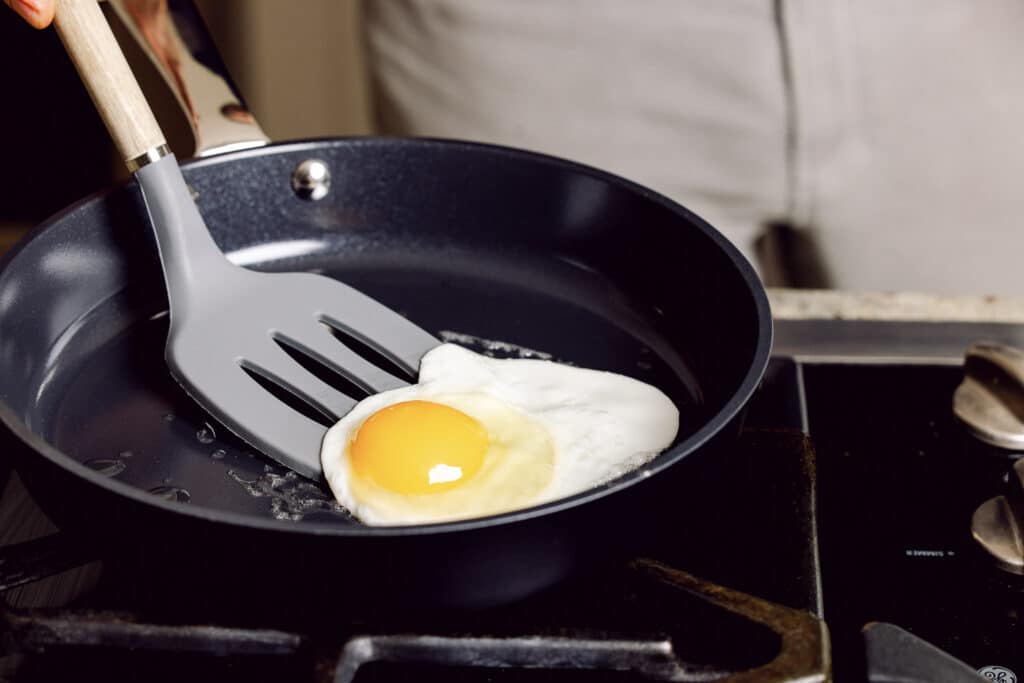
While the U.S. reports showed that the cookware passed safety regulations, our team wanted to see things like leach tests and full PFAS reports. Alva was very open about the testing, which isn’t surprising given that everything passes with flying colors. These pots and pans are genuinely PFAS-free and haven’t been found to contain or to leach any chemicals of concern.
The reports, which are now published on the Alva website and product pages, show that Alva cookware complies with strict EU food contact standards (EC1935:2004) as well as specific German, Italian, French, and Dutch food safety standards. Combined, Alva cookware has undergone at least 24 different migration, content and composition tests, in addition to tests confirming the absence of PFOA and PFOS.
Who Did The Testing? Alva used two reputable third-party testing laboratories:
- TÜV Rheinland – German-based international certification body founded in 1872, one of the world’s leading testing and certification organizations. TÜV certifications are considered gold standard in Europe and are widely recognized globally for product safety and quality testing.
- Intertek – British multinational testing, inspection and certification company operating in over 100 countries. Intertek is one of the largest quality assurance providers globally and is frequently used for consumer product safety testing, including FDA and EU compliance verification.
Many of Alva’s products are manufactured in China, which leaves a larger carbon footprint and, to date, we don’t have information about the facilities where the cookware is made or whether workers are paid a living wage and what conditions they work in.


